Publishing Exchange Server 2010 with Forefront Unified Access Gateway 2010 and Forefront Threat Management Gateway 2010


By allowing remote access to Microsoft Exchange to users who are based outside the safety of the corporate network, an organization enables its employees to take full advantage of the technology their company provides. Remote access lets employees use many devices to communicate with their peers and customers from any place and at any time.

Allowing access to corporate resources from any location, perhaps using devices that are not controlled by the organization, presents additional risk to the security of the data and services being accessed. Therefore it’s critical to take measures to ensure that the data is being accessed securely, which means implementing technologies such as certificates, firewalls, enforcing pre-authentication, and device or endpoint validation. The key concept to understand is that applying security to any solution is a multi-layered task that includes identifying the threats, reducing the attack surface area, removing unnecessary access points, and enforcing authentication. The casual attacker will usually give up after a few failed attempts to access a resource.

When you publish Exchange, Microsoft offers two software-based options: Microsoft Forefront Threat Management Gateway 2010 (Forefront TMG) and Microsoft Forefront Unified Access Gateway 2010 (Forefront UAG). Both options offer publishing wizards and security features to provide secure access to Exchange when it’s accessed from outside the safety of the corporate network.

There are other ways to publish Exchange besides using Forefront TMG or Forefront UAG. This technical guide isn’t intended to provide the only information you use for a complex organization or one with special security constraints. Instead, it’s intended only as a walkthrough to help you publish Exchange on both these platforms, using basic configuration options. If you have a large organization, it’s likely that you’ll need additional applications or have to factor in additional security considerations. Such applications and security considerations are beyond the scope of this document.

This white paper provides detailed information about publishing Microsoft Exchange Server 2010 using Forefront TMG or Forefront UAG, including how to choose between them for different scenarios, and provides specific steps you can take to configure Forefront TMG and Forefront UAG to publish Exchange 2010.

The link to download the whitepaper is :

Download details: Publishing Exchange with Forefront
http://www.microsoft.com/downloads/details.aspx?FamilyID=894bab3e-c910-4c97-ab22-59e91421e022&displaylang=en

Kind regards,

Catastrophic Failure “JV” Nerd smile

Windows Phone 7 Enterprise features overview


windows-phone-7-series[5]


Bearing in mind the release of the upcoming  Series, I would like to introduce you the high level overview of the features for the Enterprise version.

So being, TechRepublic posted a good overview that can be found in the link below :

Windows Phone 7 enterprise features overview
http://blogs.techrepublic.com.com/smartphones/?p=1111

Kind regards,
Catastrophic Failure “JV” Nerd smile

BlackBerry Enterprise Server (BES) and Microsoft Exchange Server 2010


blackberry-enterprise-server-expressMicrosoft recognized that many customers rely on BlackBerry Servers.

This is why they collaborated already closely with RIM to add BlackBerry Support to Exchange Server 2010.

BlackBerry Enterprise Server (BES) is now fully supported on Microsoft Exchange Server 2010 and BlackBerry Technical Support Services are readily available.

In order to enable full support, this updates are required:

All three of these updates are available to customers of Exchange Server 2010 and BlackBerry Enterprise Server v.5.0 with Service Pack 1 at no cost. BlackBerry Enterprise Server v5.0 Service Pack 1 and Maintenance Release 1 can be found here: http://www.blackberry.com/support/downloads

Additional information on the solution requirements, preparing the BlackBerry environment for Microsoft Exchange Server 2010, can be found on the BlackBerry site here.

Taken from :BlackBerry Enterprise Server (BES) and Microsoft Exchange Server 2010 – WSSRA
http://msmvps.com/blogs/wssra/archive/2009/12/10/blackberry-enterprise-server-bes-and-microsoft-exchange-server-2010.aspx

Regards
Catastrophic Failure “JV”
Nerd smile

Install Exchange 2007 SP3 to Windows Srv. 2008 R2


In this Post, will see the installation of Exchange 2007 SP3 on Windows Server 2008 R2. A few months ago, installing the Exchange 2007 on Windows Server 2008 R2 was not supportable.  This third service pack for Exchange 2007, enables Exchange 2007 to be installed on the Windows Server 2008 R2 version.  Let’s go to see the installation process.

Before you begin the installation process for Exchange 2007 SP3 on Windows Server 2008 R2, you must install the Hotfix KB 982720 (CDOEX on Windows Server 2008 R2 requires a registry key permission change when you install Exchange Server 2007 SP3), This enables the administrator to change the value of the registry key during the Exchange Server 2007 SP3 installation process. Otherwise (if the Hotfix is not installed) and proceed with Exchange 2007 SP3 installation, you will receive a Warning message.

Image_2

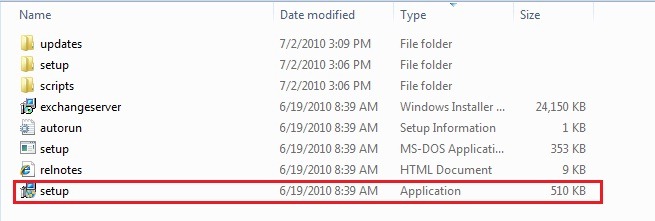
1. Go to the folder which you have download from Microsoft site the Exchange 2007 SP3, unzip the Exchange 2007 SP3 package first, then launch setup program.

Image_3

2. Follow the wizard, start to install SP3, you can see the following screenshot.

Image_4

3. Read through the introduction and click Next button.

Image_5

4. Read through the license agreement, accept it and click Next button.

Image_6 

5. Next step Readiness Checks, Setup wizard finished successfully click Install.

Image_10

9. Completion and final step is completed successfully, choose Finish.

Image_11

After the installation is complete, we’ll see the following message, which informs us that we need to reboot the system for changes to take affect.

Image_12 

After reboot we can see that our Exchange Server was installed successfully SP3, Build number 8.3.083.6.

Image_13


Additional information you can find bellow:

Enjoy….Smile

Catastrophic Failure “JV”

Exchange Server and Update Rollups Builds Numbers


exchange2010logo7333411_5DDF14B0This Wiki page lists the Exchange Server versions and Update Rollups with release dates and KB respectively.

Exchange Server

Product name

Build number

Date

Microsoft Exchange Server 2003

6.5.6944

6/30/2003

Microsoft Exchange Server 2003 SP1

6.5.7226

5/25/2004

Microsoft Exchange Server 2003 SP2

6.5.7638

10/19/2005

Microsoft Exchange Server 2007

8.0.685.24

12/9/2006

Microsoft Exchange Server 2007

8.0.685.25

12/9/2006

Microsoft Exchange Server 2007 SP1

8.1.240.6

11/29/2007

Microsoft Exchange Server 2007 SP2

8.2.176.2

8/24/2009

Microsoft Exchange Server 2007 SP3

8.3.083.6

6/20/2010

Microsoft Exchange Server 2010

14.0.639.21

11/9/2009

Exchange Server 2007 Service Pack 1

Product name

Build number

Date

KB

Microsoft Exchange Server Exchange 2007 SP1

8.1.240.6

11/29/2007

Update Rollup 1 for Exchange Server 2007 Service Pack 1

8.1.263.1

2/28/2008

KB945684

Update Rollup 2 for Exchange Server 2007 Service Pack 1

8.1.278.2

5/8/2008

KB948016

Update Rollup 3 for Exchange Server 2007 Service Pack 1

8.1.291.2

7/8/2008

KB949870

Update Rollup 4 for Exchange Server 2007 Service Pack 1

8.1.311.3

10/7/2008

KB952580

Update Rollup 5 for Exchange Server 2007 Service Pack 1

8.1.336.1

11/20/2008

KB953467

Update Rollup 6 for Exchange Server 2007 Service Pack 1

8.1.340.1

2/10/2009

KB959241

Update Rollup 7 for Exchange Server 2007 Service Pack 1

8.1.359.2

3/18/2009

KB960384

Update Rollup 8 for Exchange Server 2007 Service Pack 1

8.1.375.2

5/19/2009

KB968012

Update Rollup 9 for Exchange Server 2007 Service Pack 1

8.1.393.1

7/17/2009

KB970162

Update Rollup 10 for Exchange Server 2007 Service Pack 1

8.1.436.0

4/9/2010

KB981407

Exchange Server 2007 Service Pack 2

Product name

Build number

Date

KB

Microsoft Exchange Server 2007 SP2

8.2.176.2

8/24/2009

Update Rollup 1 for Exchange Server 2007 Service Pack 2

8.2.217.3

11/19/2009

KB971534

Update Rollup 2 for Exchange Server 2007 Service Pack 2

8.2.234.1

1/22/2010

KB972076

Update Rollup 3 for Exchange Server 2007 Service Pack 2

8.2.247.2

3/17/2010

KB979784

Update Rollup 4 for Exchange Server 2007 Service Pack 2

8.2.254.0

4/9/2010

KB981383

Exchange Server 2007 Service Pack 3

Product name

Build number

Date

Microsoft Exchange Server 2007 SP3

8.3.083.6

6/20/2010

Exchange Server 2010

Product name

Build number

Date

KB

Microsoft Exchange Server 2010 RTM

14.0.639.21

11/9/2009

Update Rollup 1 for Exchange Server 2010

14.0.682.1

12/9/2009

KB976573

Update Rollup 2 for Exchange Server 2010

14.0.689.0

3/4/2010

KB979611

Update Rollup 3 for Exchange Server 2010

14.0.694.0

4/9/2010

KB981401

Update Rollup 4 for Exchange Server 2010

14.0.702.1

6/17/2010

KB982639

Exchange Server 2010 Service Pack 1 Beta

Product name

Build number

Date

Microsoft Exchange Server 2010 SP1 Beta

14.1.180.2

6/5/2010